

Table of Contents
Single Tooth Implant vs Dental Bridge: How Do They Compare?
A single-tooth implant and a traditional dental bridge can both replace one missing tooth. The best option depends on the teeth beside the gap, the health of your gums and jawbone, your bite and your treatment preferences.
The key difference is how they are supported. An implant is placed in the jawbone and holds a replacement crown independently. A traditional bridge is anchored to crowns on the teeth next to the missing tooth.
If you are considering a single-tooth implant, a dental examination can help determine whether this option is appropriate for the area.
Quick comparison
| Consideration | Single-tooth implant | Traditional dental bridge |
|---|---|---|
| Support | An implant fixture in the jawbone supports the crown | Crowns on neighbouring teeth support the replacement tooth |
| Adjacent teeth | Often do not need preparation to support the crown | Usually need to be prepared for crowns |
| Missing tooth root | Replaces the root and visible tooth | Replaces the visible tooth above the gumline |
| Treatment approach | Usually involves surgical placement, healing and a final crown | Usually involves preparing supporting teeth and fitting the bridge |
| Home care | Cleaned around the crown and gumline, like a natural tooth | Requires cleaning around the crowns and beneath the replacement tooth |
| Planning priorities | Bone, gums, bite and overall oral health | Condition of supporting teeth, gums and bite |
The health of adjacent teeth is often the starting point
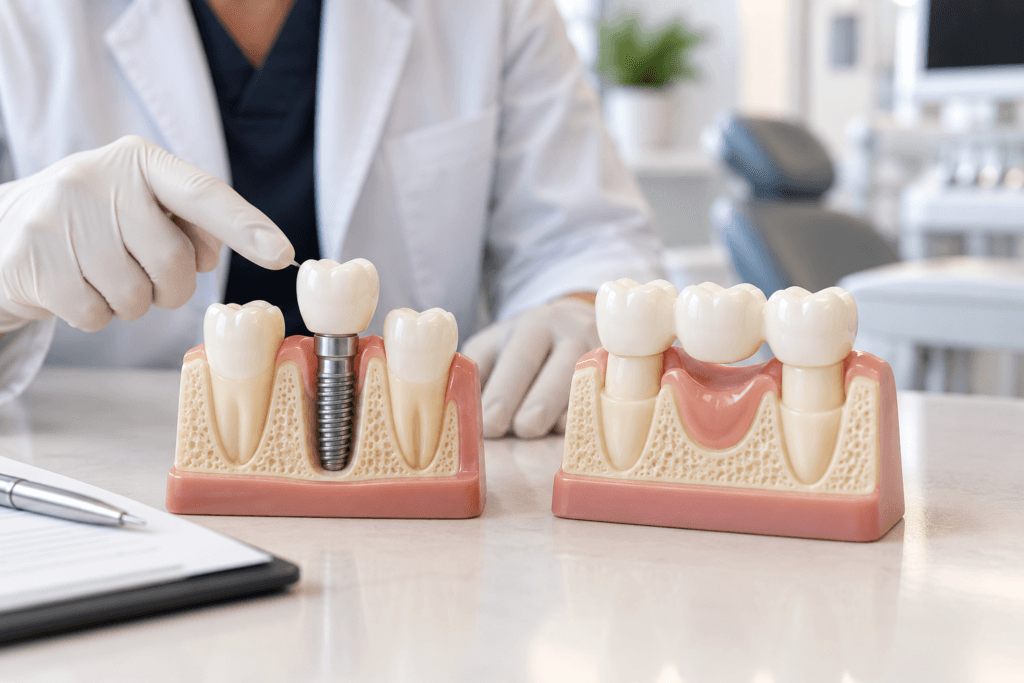
A traditional bridge relies on the teeth beside the gap. To support the bridge, those teeth are generally prepared for crowns.
This can be appropriate when the neighbouring teeth already need crowns because of substantial fillings, fractures or wear. In that situation, a bridge may address several restorative needs within one treatment plan.
If the adjacent teeth are healthy and minimally restored, your dentist may discuss whether preserving them is a priority. A single-tooth implant can often replace the missing tooth without using those teeth as supports.
How a single-tooth implant works
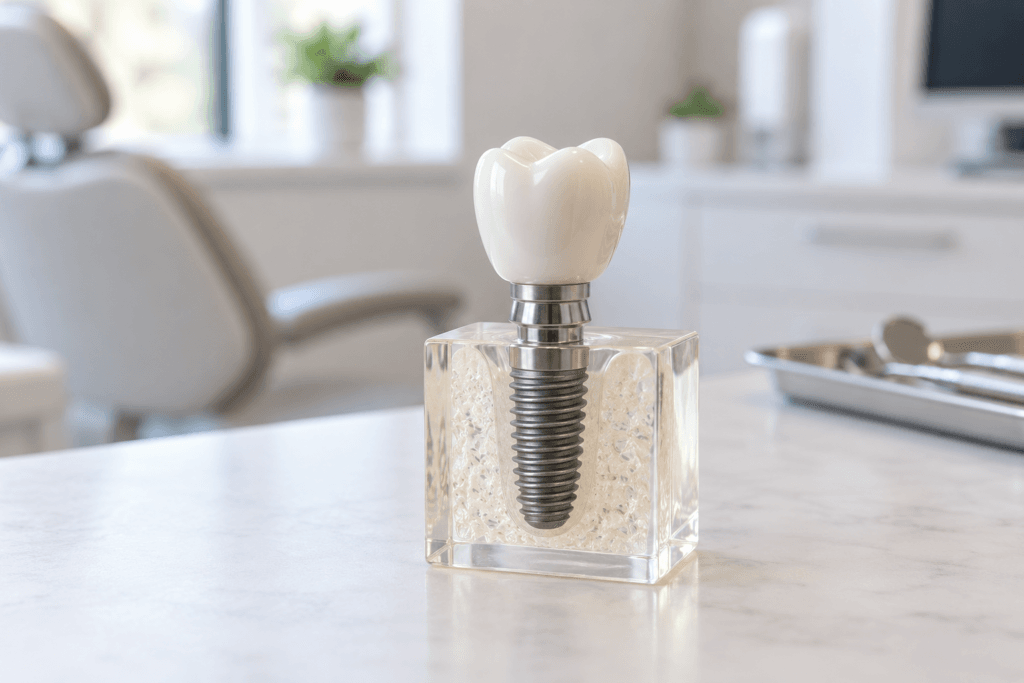
An implant replaces the missing tooth root with a fixture placed in the jawbone. After the area has healed appropriately, a custom crown is attached to replace the visible part of the tooth.
Planning for an implant involves more than looking at the gap. Your dentist considers the bone at the missing-tooth site, gum health, tooth position, bite and medical and dental history.
Some patients need preparatory treatment before implant placement, while others may not. The treatment sequence and timing should be based on a personalized assessment rather than a standard timeline.
How a traditional dental bridge works
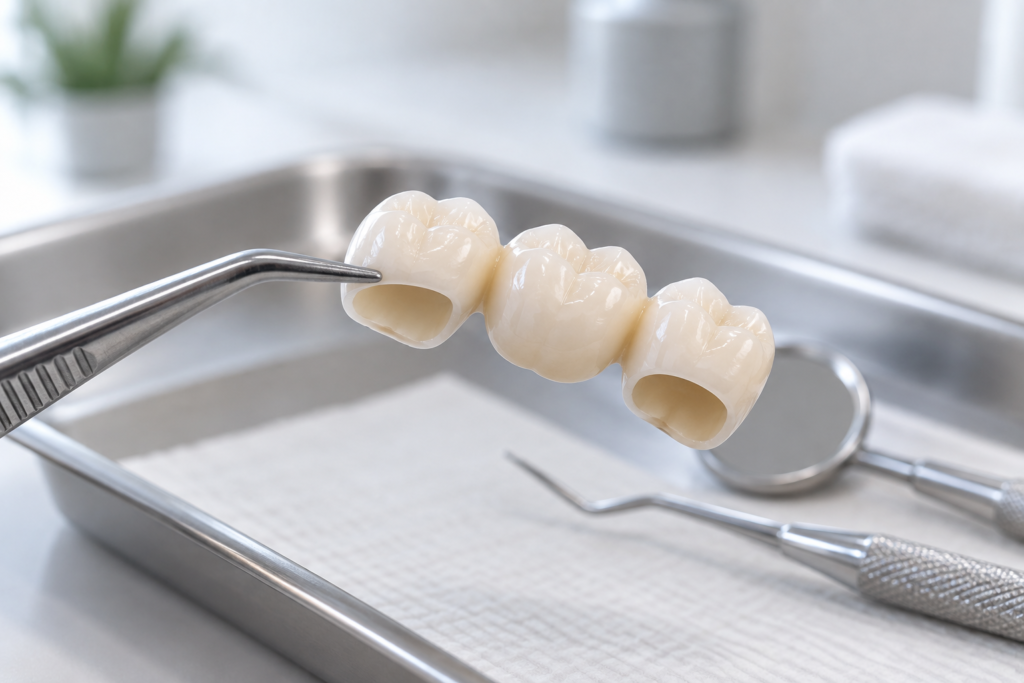
A traditional bridge fills the space with an artificial tooth, often called a pontic, which is connected to crowns on the teeth beside it.
This article compares a traditional tooth-supported bridge with a single-tooth implant. Other bridge designs, including implant-supported bridges, are planned differently.
A bridge does not involve placing an implant fixture in the jawbone. However, the health of the supporting teeth and gums remains important because they carry the bridge.
Learn more about dental bridges and crowns and how they may be used to restore teeth or replace a missing tooth.

Treatment process and timing
A traditional bridge is generally completed by preparing the supporting teeth, taking impressions or digital records and fitting the finished restoration. The number of visits depends on the treatment plan and the condition of the supporting teeth.
Implant treatment is often completed in stages. It may include placing the implant, allowing the site to heal and attaching the final crown later. The timing varies depending on the location of the missing tooth and the condition of the bone and gums.
A shorter treatment process is not automatically the best choice, and a longer process is not automatically better either. The decision should reflect what is clinically suitable and what matters most to you.
Cleaning and maintenance
Both options require regular brushing, cleaning between teeth and professional checkups.
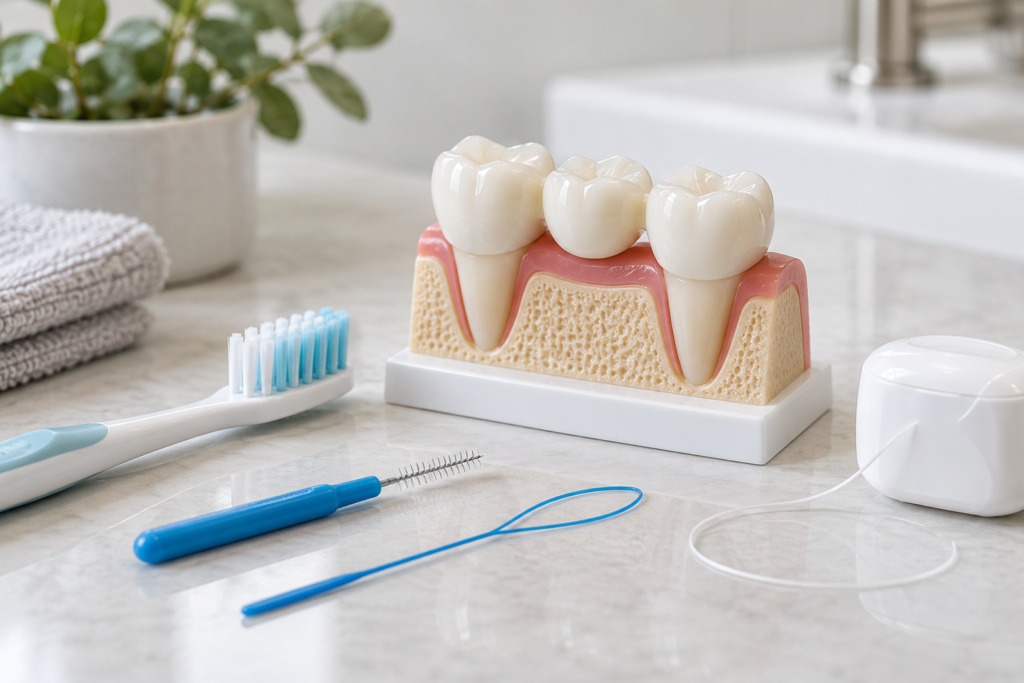
An implant crown is cleaned around the gumline and between the crown and neighbouring teeth as advised by your dental team. A bridge needs careful cleaning around the supporting crowns and below the pontic, where plaque and food debris can collect.
Your dentist or hygienist can recommend tools that suit your restoration. These may include floss threaders or interdental brushes, depending on the location and design.

Which option may suit you?
A single-tooth implant may be worth discussing if:
- The neighbouring teeth are healthy.
- You prefer an option that does not usually rely on those teeth for support.
- Your bone and gum condition are suitable for treatment.
- You are comfortable with a surgical procedure and a staged treatment plan.
A traditional dental bridge may be worth discussing if:
- The teeth beside the gap already need crowns or significant restorative work.
- Implant placement is not appropriate for your oral or medical circumstances.
- You prefer a non-surgical treatment path.
- Your dentist determines that a bridge is the more suitable choice for the area.
A written treatment plan can help you compare the recommended option, reasonable alternatives and the fees that apply to your own case.
Frequently Asked Questions About Dental Bonding
Not necessarily. Whether a graft or another preparatory procedure is needed depends on the amount and condition of bone at the missing-tooth site. Your dentist can assess this during implant planning.
Sometimes, but the sequence depends on why the tooth was removed, the condition of the gums and bone, and the health of the teeth that would support the bridge. Your dentist can explain whether a bridge is appropriate and when it could be placed.
Costs vary because each treatment plan is different. An implant plan may include surgery, a crown and, in some cases, preparatory treatment. A bridge includes the replacement tooth and crowns on the supporting teeth. Insurance reimbursement and your personal out-of-pocket responsibility depend on your plan, so request a written estimate.
Neither option should be described as permanent. Longevity varies with oral hygiene, gum health, bite forces, dental habits, regular professional care and the condition of any supporting teeth. Your dentist can discuss maintenance and future repair considerations for each option.
Single Tooth Implant vs Dental Bridge: Choosing the Right Option
Both a single-tooth implant and a traditional dental bridge can be appropriate ways to replace one missing tooth. An implant may be appealing when preserving healthy neighbouring teeth is important. A bridge may be a practical option when those teeth already need crowns or implant treatment is not suitable.
To discuss your options, Revita Dentistry in Brampton can assess the missing-tooth site, surrounding teeth and bite and help you make an informed decision.